Add MobilityArena as a preferred source on Google
Android P is not available to the public yet, but a developer preview has been pushed out. One key benefit of this next version of Android OS is that it will prevent apps from using your smartphone’s microphone or camera whenever they’re in the background and not actively being used on screen.
If you have been worried about secret recording activity happening on your phone, Google has got your back with Android P. Whenever an app in the background tries to use your microphone or camera, a new security feature will trigger a notification to tell you and you can decide to let it happen or not.

So, Android P is big on user privacy. Are there any other new stuff? Yes, there are.
Display Notch Support
Remember how Android smartphone manufacturers went crazy with display notches at Mobile World Congress 2018 ? Well, Google approves and has added support for display notch in Android P.
New Notification Panel
Android OS gets a new notification panel and improved messaging notifications.
Wi-Fi Indoor Positioning
Indoor positioning via Wi-fi means your smartphone will be able to measure the distance to multiple Wi-fi hotspots and use this information in indoor positioning apps to calculate the near exact location of the phone with an accuracy of 1 to 2 meters.
New Media Formats
Android P adds support for HDR VP9 Profile for video and HEIF image compression.
HDR VP9 makes it easier to watch HDR videos, while HEIF is a new image compression format that can compress images to less than half the size of a JPEG while maintaining higher image quality.
Multi-camera API
We are in the age of dual and triple camera. Perhaps we shall even see quad cameras soon. Android P includes native support for multiple cameras.
Think of using twitter and wanting to share a quick selfie, so you call up the camera from inside the tweet you are composing. You will be able to use zoom or even bokeh in that situation.
There has been no mention of Bluetooth HID device profile that enables your smartphone as an input device.
Get Android P Developer Preview
Android P won’t be ready for the public until 3rd or 4th quarter 2018, so it is still a long way off. If you are a developer and need to test out things with your apps, you can download and use Android P Developer Preview right away. Just head this way .
Author:InfoDesk
Add MobilityArena as a preferred source on Google
If we were to throw the question, Which smartphone has the highest screen-to-body ratio ? to the general public, the most common answer would probably be, “iPhone X” But that would be a wrong answer .
A bezel is the frame around the display of a cell phone. In recent times, we have seen the rise of bezel-less phones. In truth, they are not 100% bezel-less, as there is still a frame around the display of all existing phones, but the term “bezel-less” has been adopted to refer to phones with less bezels. The smaller the bezels, the higher the screen-to-body ratio of the phone.

Huge bezels mean a lower screen-to-body proportion. Smaller bezels result in a higher ratio.
In other words, a smartphone with a higher screen-to-body proportion has more efficient use of space on its front end. There is more screen to use and a narrower frame to hold. Usually, low-end phones have the biggest bezels, meaning that most bezel-less smartphones are high-end. The image below is that of a phone with huge bezels.
We have seen a few cheap bezel-less smartphones though, like the Alcatel 3C , Lenovo k320t , and Panasonic Eluga C . If we were to throw the question, Which smartphone has the highest screen-to-body ratio? to the general public, the most common answer would probably be, “Apple iPhone X”. But that would be a wrong answer, regardless of how many people think so.
We bring you a definitive list of some of the smartphones with the highest screen-to-body proportions in first quarter 2018. It is an interesting list!
Smartphones with the highest screen-to-body ratio
This is a countdown from the number 5 spot all the way up to the first position where the smartphone with the highest screen-to-body proportion sits. Let’s go.
5. 82.9% screen-to-body proportion
Yes; Apple’s iPhone X is one of the phones with the highest screen-to-body ratio. But it is in the number 5 spot on the list, meaning that there are quite a number of other smartphones with a higher screen-to-body ratio.
4. 83.2% screen-to-body ratio
A number of flagships from 2017 jointly occupy this position and they include Samsung Galaxy Note 8 and LG V30. They have one of the highest screen-to-body ratio on a smartphone today
3. 83.6% Screen-to-body ratio
Smartphones from Mobile World Congress 2018 dominate this space. They include the Samsung Galaxy S9 , Asus Zenfone 5 and Asus Zenfone 5Z . Another phone sharing this spot is the Xiaomi Mi Mix .
2. 84.2% screen-to-body ratio
The newly-announced Samsung Galaxy S9+ has an 84.2% ratio, beating last year’s S8, S8 Plus and Note 8 by small margins. It has one of the very highest screen-to-body ratio around on a phone today.
1. 84.9% screen-to-body ratio
With an 84.9 percent ratio, the Essential Phone has the highest screen-to-body ratio of any smartphone in existence now.
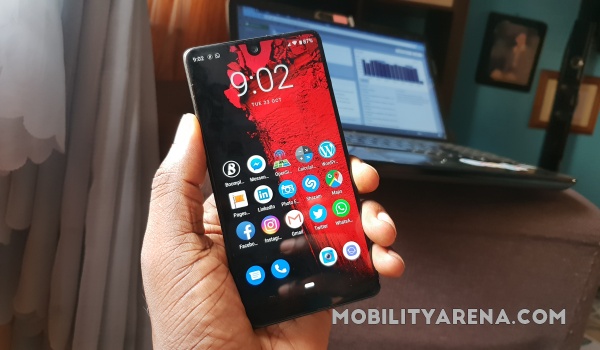
The Essential phone was also the first smartphone with a display notch, which was later popularised by the Apple iPhone X, and is now spreading like wildfire among other smartphones . It is very likely though that a mobile brand will announce a phone with a higher ratio than the Essential’s 84.9% this year.
A number of smartphone brands are hard at work to reduce the bezels on their devices some more. And then, we will have this list updated. It is a bezel-less world we live in and one day, technology will be advanced enough to give us a 99% screen-to-body ratio.
Please help us keep this list up-to-date: alert us of new phones that belong on this list of the highest screen-to-body ratio phones.
Author:Mister Mobility
Digital Skills and Communication Coach | Mobile Phone Connoisseur since 2001 | Tech Blogging since 2004
