Add MobilityArena as a preferred source on Google
We’ve had the iPod Touch 5th Gen for quite a while now. This review has been long coming except for a bit of laziness on my part. After about a month of using this iPod, Here’s a low down of things I love and hate about it.
- The Good Parts of Apple iPod 5th Gen
- The Ugly Side of iPod 5th Gen
The Good Parts of Apple iPod 5th Gen

1.) The Compact Size: The Apple iPod 5th Gen is small sized and compact. With a 4 -inch screen it fits well into my hands – just the way I love it. The device is very thin with a polished metallic finishing. Almost everyone that has handled this iPod commends the premium design. If you’re the kind that likes it small and compact, this iPod is a nice fit for you.

2.) Great Camera: Oh the camera!! This iPod is has an amazingly great camera. The color reproduction is excellent and the sensor takes in lots of details, many thanks to Apple technology. It might interest you to know that iPod 5th Gen has 5 MP rear camera with flash, but then, the results are way beyond what you find on other devices of same megapixel rating. Above is one of the shots I took while in NYSC camp. The selfie camera is also great, even though its just 1.2 MP. Zoom in twice, and the quality remains decent.
3.) Music Quality: The iPod Touch 5th Gen is another wonderful music player. To really enjoy your music, make sure you use Apple earphones or any other premium one. If you can pass through the hurdles of adding music through iTunes, the rest is bliss. The external speaker is not loud, so you can leave it out.
4.) Battery life & Fast Charging: This device has a very great battery life. The iPod 5th Gen can last you a whole day and more for just music playback, after full charge. For watching movies or gaming, it lasts for about 8 hours before running down. Originally, the iPod doesn’t have fast charging technology incorporated, but this device charges fast. It takes 1 hour to charge fully from 0 – 100%.
5.) iBooks & Large App Repository: Coming pre-installed is an ebook reader, iBooks. Using iTunes one can add books of various formats : pdf, epub, etc. I love the way the app renders pages in a neat and orderly manner.
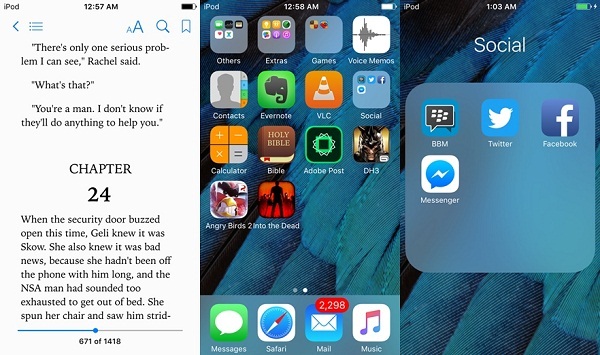
There’s also the gift of Apple App Store. With WiFi connected, I was able to download and try out a few apps and a list of games. So much to explore.
TheUgly Sideof iPod 5th Gen
1.) The iOS problem: You can’t share files through Bluetooth, there’s no system-wide file manager to arrange your files. The availability of Xender partly reduced the file sharing problem, but sadly, any file you collect through Xender can only be accessed within the app. Each app houses it’s data seprately and there’s no way of collating them in one place. Sad really.
2.) Enforced iTunes: This device is useless if you don’t have a PC around with iTunes installed. You’re forced to look for the nearest PC with iTunes before you can add content (music or videos) to it.
3.) Poor external speaker: The external speaker of this iPod has a low volume. To enjoy your songs it’s best to use a pair of earphones or headset.
Despite the setbacks, the Apple iPod 5th Gen has turned out to be my favourite companion. Keeping me occupied on the road, during lunch breaks or when I just want to relax. This device is ideal for those that would like to have a first taste of iOS without breaking the bank. Cheers.
Author:Etoniru Chibueze
Chibueze is an award-winning gadget reviewer and geek. He loves research, while living and breathing tech. You can reach him on Facebook, Twitter ,OR LinkedIn
Add MobilityArena as a preferred source on Google
While the first mobile phone prototype was the Motorola DynaTAC, on which Martin Cooper made the first publicized mobile phone call on 3 April 1973, cell phones largely remained a voice and text message affair for another 20+ years. The first mobile phone with Internet access did not arrive until the mid-1990s.
The first commercial mobile phone with internet capabilities – web browsing and email – was Nokia’s first “Communicator”, the 9000. Communicators were laptop-style phones that opened up to reveal a full QWERTY keyboard and large display. The first generation of Communicators were the forerunners of the modern smartphone. It was was released in 1996 and ran the GEOS 3.0 operating system. The 9000 also had fax. Remember fax?
- Which company made the first Internet-enabled mobile phone?
- What year was the first phone with Internet made?
- What was the first mobile phone with Internet access?
- The first Web-enabled mobile phone in the world
- What is AT&T Pocketnet?
- Early Web Browsing On Mobile Phones
Which company made the first Internet-enabled mobile phone?
Who made the first phone with Internet? No; it wasn’t BlackBerry or Apple. The first phone with Internet was around for over a decade before Apple made the first iPhone. Finnish mobile phone manufacturer, Nokia, made the first Internet capable mobile phone.
What year was the first phone with Internet made?
Internet access first arrived mobile phones in the year 1996. The first mobile phones with Internet access arrived that year and included both an unproduced prototype by PocketNet and the first production phone by Nokia.
What was the first mobile phone with Internet access?
Nokia 9000 Communicator was the first production phone and the first smartphone with Internet access.
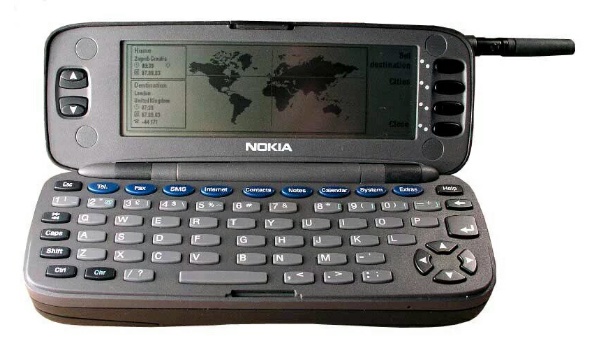
The first phone with Internet access was Nokia 9000 Communicator
The first Web-enabled mobile phone in the world
While Nokia 9000 was the first production phone with Internet access, another device – a prototype that never made it to production – had Internet access before Nokia’s first Communicator. It was known as the AT&T PocketNet Phone, a product of a collaboration betweeen AT&T and Unwired Planet.

AT&T PocketNet Phone never made it to production
What is AT&T Pocketnet?
AT&T Pocketnet was a revolutionary new service in 1996 that was designed to “display data on a mobile phone’s small three-line, liquid-crystal display screen for sending and receiving E-mail and other information” ( source ). The AT&T PocketNet Phone was to be the first cell phone to run the new service. So while it was the first mobile phone with Internet access in a pre-production environment, it did not proceed beyond functional prototype stage.
The PocketNet had a tiny screen and an alphanumeric keypad like today’s feature phones. For Internet access, it used Circuit Switched Data (CSD). In other words, dial-up Internet. To get your email or browse the Web, you had to dial into the mobile network. I still used CSD in the early 2000s and remember that it was an expensive affair.
So, the first mobile phone with Internet access connected via dial-up. Packet data like GPRS and EDGE followed years after and delivered much faster Internet access. And then came 3G, 4G, and 5G Internet.
Early Web Browsing On Mobile Phones

Note that the early web on mobile phones was more of lines of text. Early mobile web technology was based on a now-obsolete markup language called WML (Wireless Markup Language) and was popularly called WAP (Wireless Application Protocol). I learned WML in my early years of web design and hand-coded my first mobile-friendly blo pages in WML.
While the PocketNet Phone never made it to the factory, Nokia’s 9000 Communicator did. And with a much larger display and laptop-style design, it was better suited to the task. And it also one-upped the PocketNet phone by being the first mobile phone with a graphical web browser. Its web browser was more advanced than what was on the AT&T phone.
The Nokia 9000 was not only the first mobile phone with Internet access, it also towered head-and-shoulder above everything else in the market at the time. Nokia followed it up with other Internet capable phones like the Nokia 7110 in 1999. The 7110 was the first normal mobile phone with a WAP browser.
Future editions of the Communicator range of phones later ran EPOC OS and then Symbian OS. The 9000 was followed by the 9110/9110i, 9210/9210i, 9500, 9300/9300i, E90, and E7. The Nokia Communicator series were the T-Rex of their day, alpha devices that were ahead of others in most ways.
Whether it is the non-production AT&T PocketNet or the production Nokia 9000 that sold globaly, the first smartphone with Internet access was a clunky brick. Neither of them were basic devices.
Author:Mister Mobility
Digital Skills and Communication Coach | Mobile Phone Connoisseur since 2001 | Tech Blogging since 2004
