Add MobilityArena as a preferred source on Google
You might never have paid much attention to your car’s auxiliary power outlet or outlets (some cars have multiple outlets), but they are important if you charge your phone while on the move.
You definitely should pay some attention to these outlets, as their specifications, along with the specifications of the charging adaptor and cable that you use, and the charging specifications of your phone, all together, determine how well and how fast your smartphone will get charged in the car.

To repeat it, how fast you can charge your smartphone in your car depends on three things: the charging specs of your phone, the charging specs of the power adaptor and cable you are using, and the rating of the car’s auxiliary power outlet itself.
Once you understand this, you will be able to get the fastest charging speed when charging your smartphone in the car.
Types of car auxiliary power outlets
There are two types of auxiliary power outlets in cars. In all my years of driving and owning multiple automobiles, I have seen only those two.
Cigarette Lighter Sockets : These deliver 12V DC power and are commonly found in vehicles. They also have higher amperage, allowing them to deliver more power to the devices you are charging.
USB Power Outlets : These come in different sizes and cater to either 5-volt or 12-volt systems in vehicles. They offer flexibility in charging options. They also provide much lower amperage than cigarette lighter sockets, and so are significantly slower at charging devices.
The higher the voltage and amperage, the higher the wattage. The higher the watts, the faster the charge. That’s a simple rule to remember.
How do you know what ratings the power outlets in your vehicle support. You can get detailed info about the voltage, amperage, and wattage of your vehicle’s auxiliary power outlets by flipping through the car manual or checking the labels on the power outlets themselves.
My current vehicle has three auxiliary power outlets – one cigarette lighter socket, one regular 5W USB port, and one 12V / 120W USB port. Looking at the label in my automobile’s cigarette lighter socket, it says that the total power when using all the auxiliary power outlets is 120W.
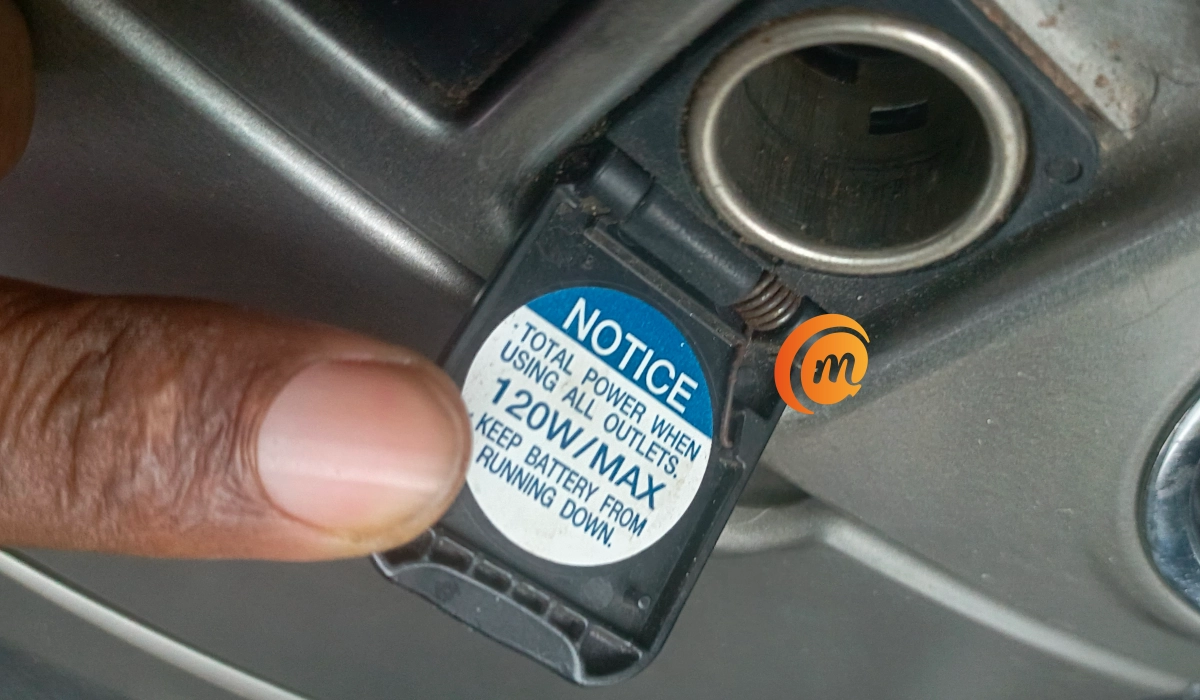
If using the cigarette lighter socket alone, or the 120W USB port alone, either can deliver the full 120W. But should I plug in multiple devices, the full 120W is distributed in smaller chunks through all the connected ports.
How safe are car auxiliary power outlets for charging smartphones?
Car auxiliary power outlets are generally safe for charging your smartphone and other devices, inclusing laptops. Do note that it is possible to put too much demand on those outlets.
For example, I have an adaptor for charging my laptop while on the road. I have observed that it gets quite warm, and even hot, quickly when I am using it. This is because of the demand that the laptop power adaptor is putting on the power outlet.
Sometimes, especially in hot weather, when charging my phone in the car, the phone warms up as well.
Thankfully, many modern smartphones have protective systems built into them. For example, if my phone is beginning to overheat while I am charging it in the car, it notifies me, so I can disconnect it for a while to let it cool down.
How fast are car phone chargers?
Modern car phone chargers and auxiliary power outlets support fast charging technology. It might surprise you to know that there are car phone chargers that support up to 75W and even 100W charging.
For the fastest charging possible, get a fast car phone charger that matches your smartphone’s fast charging technology and plug it into your vehicle’s cigarette lighter socket. As I already mentioned, car USB ports have a 5W rating, while the lighter sockets are rated 12V.
If your phone supports 45W charging, you need a car charging adaptor that supports 45W for you to get the best charging speed possible out of it.
My current smartphone supports 45W fast charging, while my current car charger supports only 36W, so I am not getting the fastest charging speed possible. But 36W is fast enough; the difference in actual charging time between 36W and 45W isn’t significant.
A few important things to know about charging your phone from a car auxiliary power outlet
Charging your phone using a car auxiliary power outlet in extreme weather conditions will impact charging speed and can also damage your device. For example, if you notice that your device is heating up significantly while charging it in the car, disconnect it for a while.
Also, note that GPS Navigation apps (Google Maps being an example) are serious power drainers. Car auxillary power outlets cannot keep up when such power-intensive apps are in use. That means, though your smartphone is plugged in while using such an app, the phone will keep losing battery power. You read that right.
I have experienced this multiple times when on a fairly long road trip. A way around this issue is to shut down your GPS navigation app when on a stretch of road that you are familiar with, to allow the battery charge up a bit. Run the navigation app only when you really need it.
Of course, if you are going to need GPS navigation aids a lot on a road trip, it is a good idea to ensure that your phone battery has a full charge at the beginning of the trip.
Also, if charging your devices in the car while the car is stationary, it is a good idea to keep the engine running. This is to reduce the risk of running down your car battery. The heavier the charge your device(s) needs, the greater that risk.
Car phone chargers I have used
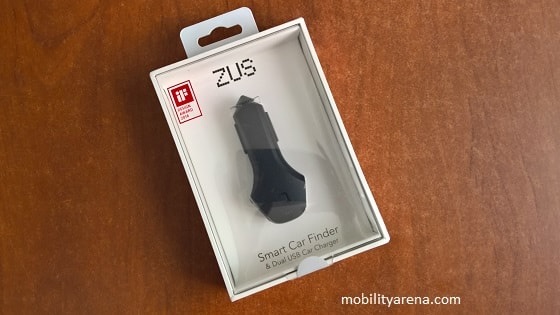
I have used a number of car phone chargers, over the years. They include models by ZUS , Sony, IQ, and Heatz. I very much prefer to use a dual-port charger in my car, so that when needed, two devices can be charged at the same time. This is important when there are other people in the car with me, especially during a long drive. Yes, I am hospitable like that. Thank you.
My car’s cigarette lighter socket is my preferred auxiliary outlet for charging my phone, and that’s where it is always plugged in. Using a dual-port car phone charger means I can get decent charging for two devices at a time.
But my car’s regular 5W USB auxiliary power outlet is great for charging dumb phones and feature phones because of the lower power ratings. Charging a smartphone through that particular USB outlet is a painfully slow experience, which is why it is not my favourite.
The other USB port is rated at 120W and does much faster charging that is at par with what the cigarette lighter socket does. It is great for charging smartphones with fast charging capabilities.
Of course, the USB ports require no power adaptor. Just plug in your USB cable to charge your phone. A USB-C cable is more capable for faster charging speeds.
The nonda ZUS Smart Car Charger is rated 24W, which allows it to charge my smartphone relatively fast when plugged into the lighter socket.
Currently, I use a Heatz dual-port car phone charger. It supports Qualcomm Quick Charge 3.0 , and a combined output of 36W through its two ports. That provides me really decent charging times for my smartphone when I am on the road.
Author:Mister Mobility
Digital Skills and Communication Coach | Mobile Phone Connoisseur since 2001 | Tech Blogging since 2004
Add MobilityArena as a preferred source on Google
We are living what was once science fiction to a past generation. Imagine telling someone back in the late 90s and early 2000s that one day, it would be possible to charge a cell phone from zero to full in under five minutes, and they’d likely call you a dreamer. That is exactly what 300W fast charging offers.

I was around in the early 2000s and remember what charging phones then was like. You would need to have your cell phone plugged in for two to three hours in order to get a full charge from zero.
As a matter of fact, the best way to get a full charge was to leave the phone plugged all night. Any other time of the day and you’d almost be unable to leave your phone plugged and unused for three hours at a stretch.
Today, thanks to fast charging technology, we are able to charge many smartphones fully from zero or ear zero in about an hour. This is bearing in mind that modern smartphones are power guzzling monsters with massive batteries.
300W fast charging
300W fast charging solutions can take your phone battery from zero to full in under five minutes. Think about that for a minute. With that kind of technology, you would never have to worry about running out of battery juice and how to top it up, again, no matter how hectic the situation. All you would need is five minutes, and your smartphone is ready for a full day of use.
It is an amazing thing, in real life. You probably wouldn’t grasp how mind blowing this is until you experience it. And once you do, you would never want to ever have to use anything less than that.
When will the first smartphone with 300W fast charging arrive in the market? That is difficult to say. Back in 2023, Xiaomi had spoken of its plans to develop this technology, but till now, nothing has been heard from them. Now in August 2024, another Chinese phone brand, Realme, has teased us with their own 300W fast charging solution in the works.
Perhaps it will happen this year, now that there is some competition over it. Let’s see who will beat the other to it. One thing is certain, we are seeing a growing amount of innovation around battery capacity and battery chargers .
We already have smartphones with 240W fast charging technology in the market. These includes pioneers like the Realme GT3 and Realme GT5 240W. 240W fast charging fills up the batteries of these phones in 10 minutes max. Even that is already super impressive. But I am itching for the reality of getting a full charge in five minutes that 300W fast charging promises.
The fastest charging technologies are being developed by Chinese smartphone brands and no-one else is coming close. Fast charging solutions by Samsung, Apple, and Google are super slow in comparison. Pitted against what brands like OnePlus, Xiaomi, Huawei, Infinix, OPPO, and Realme are deploying, there is no competition. The Chinese are the fastest kids on the block and are hundreds of miles ahead of the rest of the pack.
320W SuperSonic Charge by Realme becomes the fastest charging technology for smartphones
August 14, 2024, Update : Realme provided details of its 320W charging technology, called SuperSonic Charge. The new technology fills up a smartphone’s battery in 4 minutes and 30 seconds. The battery will go from zero to 50% in less than two minutes. Again, Realme maintains the lead in mobile phone fast charging solutions, as 320W charging becomes the fastest smartphone charging technology in the world.
According to Realme, the 320W power adaptor supports charging standards like Power Delivery (PD), Universal Fast Charging Specification (UFCS) , and SuperVOOC. The 320W adapter is called “Pocket Cannon”. It is the UFCS standard that delivers the 320W charge.
Author:Mister Mobility
Digital Skills and Communication Coach | Mobile Phone Connoisseur since 2001 | Tech Blogging since 2004
