Add MobilityArena as a preferred source on Google
Protecting your laptop whilst going about your daily business should be of the utmost importance to anyone that is not willing to part ways with their pocket computer in an untimely manner, and the number of different ways you could be putting your laptop at risk every single day is likely going to shock you.
Fortunately, with just a few simple tips and tricks, keeping your laptop safe can become second nature, and you will never have to worry about any harm coming to your laptop ever again. Let’s jump straight into it and talk about a couple of ways you can protect your laptop while out and about.

A Sturdy Case Can Make All The Difference
One of the simplest yet most effective ways that you can protect your laptop is simply by getting a strong/secure case. There are a ton of sturdy laptop cases that will more than fit the bill, and in reality, as long as you get something that is strong and reliable, you can’t go wrong.
As you would expect, the primary use for getting a good quality laptop case would be to provide extra protection in the case that any drops were to occur. However, there are actually a plethora of different ways a case can keep your laptop safe, some of which you may have never even thought about.
For one, if you happen to put your laptop in a bag whilst going around town, the chances that some of the other objects in said bag are going to damage it are extremely high. Of course, this is only likely to be minor scrapes and scratches; but with laptops being as expensive as they are, it’s just not worth the risk.
In addition to this, some laptop cases may be able to deter potential thieves (especially if you get one with a lock), and this can be a great preventive method to stop any theft attempts in their tracks before things escalate.
The examples we have given are but a few of the many ways a laptop case can protect your laptop – for such a simple change, the number of ways it can affect you is unimaginable.
It’s Always Better To Be Safe Than Sorry
You’ve heard it time and time again; it’s always better to be safe than sorry. Well, this notion applies itself perfectly to expensive possessions akin to a laptop. Getting suitable laptop insurance is always going to be your best bet of ensuring you are always going to be good, no matter what situation may occur.
This is even all the more critical if you happen to use your laptop for work or school. Listen; laptops getting stolen is incredibly common. Nobody thinks it’s going to happen to them until it does. Even if you take every preventive step in the world to guarantee the safety of your laptop, thieves will always be around and accidents will always happen.
Taking this into consideration, it goes without saying that getting laptop insurance is going to be the right course of action for the vast majority of people.
Even if you have a Ghost Lock on your car and have your laptop wrapped up in the most secure case imaginable, there is nothing to stop an opportunistic thief from trying his luck, and you cannot guarantee that he isn’t going to be successful in his attempt.
Getting your bases covered in the case that anything were to go amiss is your best bet, and if you can afford it, going for laptop insurance is likely going to be a great idea.
So, do you think you will take to implementing any of the tips we have given you throughout this article? If you do, you will be increasing the protection of your laptop exponentially. We don’t truly know how much we value something until it’s gone, and all it takes is one drop or one pesky thief to come and make you feel the full brunt of this sentiment.
Although, if you follow the advice in this article, this is no longer something you are going to have to pay all too much attention to. Good luck – we hope your Laptop stays with you for years to come.
Author:Anna Makama
Gadget lover making my way through life one day at a time.
Add MobilityArena as a preferred source on Google
Mobile CPUs are the center of the operations of any smartphone. As such, mobile CPU manufacturers play an important role in the industry. The most popular mobile CPU manufacturers are Qualcomm and MediaTek, but there are others, and I provide the list further down in this article.
You have seen the words and terms like CPU, chipset, processor, and SoC used when referring to smartphones. They can be quite confusing, especially if you are not a technical person. What are they? I provide answers below.
- What is a CPU?
- What is a GPU?
- What is RAM?
- What is a chipset?
- What is an SoC?
- Other components you may find inside a smartphone’s SoC
- List of Mobile CPU Manufacturers
What is a CPU?
The CPU, or Central Processing Unit , is the main processor in the computer or smartphone. It does all the calculations or processing of data. Which is why it is also known as the processor. The CPU or processor is the brain of the smartphone.
What is a GPU?
The GPU is the Graphics Processing Unit , and as the name suggests, it controls issues pertaining to how well graphics are displayed on the screen. As such, GPUs are critical to gaming, video playback, etc. The more powerful the GPU is, the higher the quality of images and videos on the screen. In other words, Graphics Processing Units determine the quality of the overall viewing experience. If you edit images and videos on your mobile device, the GPU is also key to how well those activities run.
What is RAM?
Random Access Memory (RAM) is a kind of temporary memory that provides for stored data to be received and read almost instantaneously. When you launch an app, its data is immediately written to RAM, so the app can run more efficiently. It is different from the storage memory, also called built-in memory, of a phone, which is for storing files like photos, videos, documents, etc. The bigger and faster the RAM, the more smoothly apps work on your smartphone.
What is a chipset?
A chipset is a collection of integrated circuits which are designed to function together as a unit, especially to perform a particular task within a computer system (including smartphones). It controls the communication between the CPU, RAM, internal storage, USB components, and other peripherals. A chipset can be implemented as an SoC or on a motherboard. I explain further below.
What is an SoC?
A System on a Chip , System-on-Chip , or SoC, is a single silicon chip, or integrated circuit, that integrates the CPU, GPU, network modem, and other components in one package. All these components can also be used together by plugging them to a motherboard (and this is often how it is done in PCs, but the SoC approach has them all built into a single microchip, and this is how it is often done in smartphones.
To reiterate how an SoC works, all computing systems have a CPU, GPU, RAM, ROM, and other components, and when a motherboard is used, all of them are connected as detachable or replaceable components. When a System on Chip (SoC) is used, they are all built into one microchip – none of those components are detachable or replaceable. As such, in cell phones, the words chipset and SoC can be used interchangeably.
Other components you may find inside a smartphone’s SoC
Besides the CPU, GPU, RAM, and ROM, there are other components that are typically found inside a System-on-Chip. Here are a few:
- Integrated Modems : These convert wireless signals into data your phone understands. Types of modems found in phones include 2G, 3G, 4G LTE, 5G, Wi-Fi, and Bluetooth modems.
- Image Processing Unit (ISP) : These convert data from the smartphone’s camera into image and video files.
- Digital Signal Processor (DSP): These handle more highly intensive functions like decompressing music files and analysing data from a gyroscope sensor.
- Neural Processing Unit (NPU): Also called neural processors, these are used in more high-end smartphones to process AI (artificial intelligence) computing and applications. Their functions include processing facial recognition, voice recognition, and camera object segmentation.
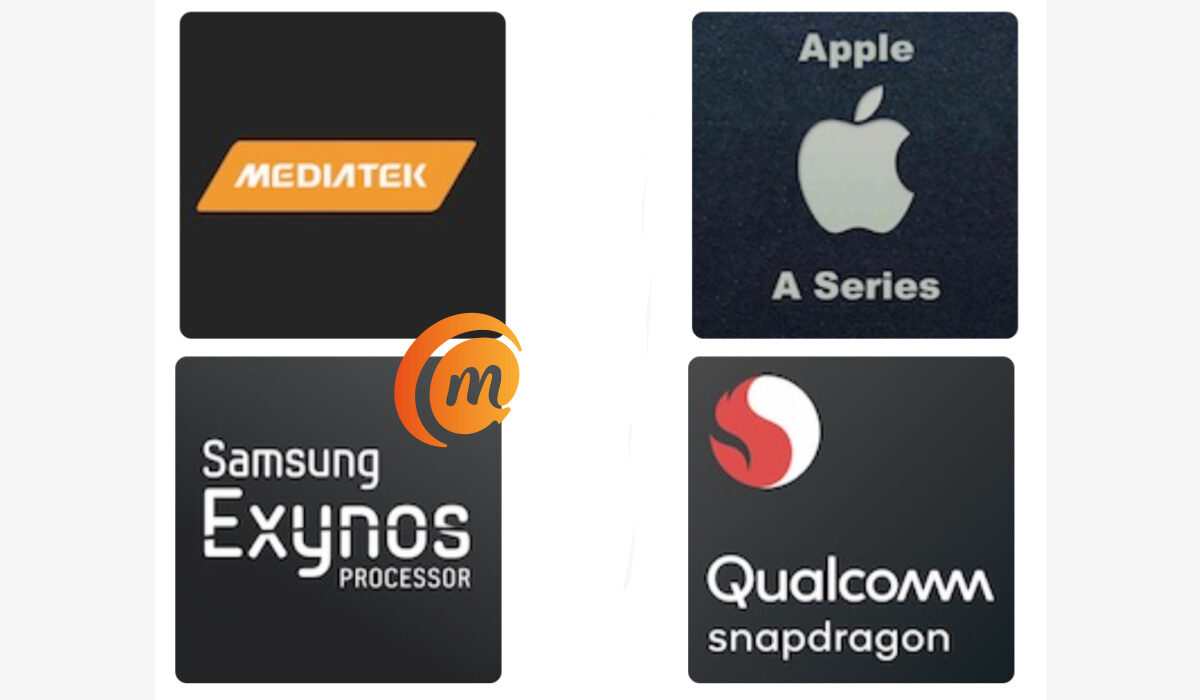
Mobile CPU Manufacturers and Brands
List of Mobile CPU Manufacturers
- Qualcomm : This is an American company that makes the Snapdragon brand of chips. Qualcomm is the leading chipset maker, globally. Have a look at our Snapdragon chipset ranking .
- MediaTek : This is a fast-growing Chinese mobile CPU manufacturer. They produce chipsets branded in their own name, as well as those carrying the Helio and Dimensity labels. MediaTek’s chipsets are in use by almost every smartphone brand in the world.
- Apple Bionic : Apple’s Bionic chips are some of the most powerful in the smartphone industry. They are used only in iPhones, iPads, and iPods.
- Exynos : This chipset brand is owned by Samsung and are used only in Samsung smartphones. Check out our Exynos Chipset list .
- Unisoc : Formerly known as Spreadtrum Communications, Unisoc produces chipsets for low and medium-end cell phones. Their chips have been used by many smartphone manufacturers.
- HiSilicon : This mobile CPU manufacturer is owned by Huawei and the chips are found only in Huawei and Honor smartphones.
- JLQ Technology : This brand is relatively new on the scene and as far as I can tell, it has been used only by Xiaomi (in the Poco C40 ) at the time of this article.
Hopefully, this article has given you a clearer understanding of what CPUs, GPUs, chipsets, and SoCs are and how they work. And hopefully, you are also now more conversant with mobile CPU manufacturers, whose work is essential to the functioning of your smartphone.
Author:Mister Mobility
Digital Skills and Communication Coach | Mobile Phone Connoisseur since 2001 | Tech Blogging since 2004
