Add MobilityArena as a preferred source on Google
What is ICE Emergency Contacts in a cell phone? Does your smartphone allow you to specify ICE contacts that can be dialled even when the phone is password-locked? How can you add ICE emergency contacts to your cell phone?
I had a conversation about how smartphones should be able to specify emergency contacts that can be dialled even when the phone is locked. It was then I found out that Samsung has that feature built into its smartphones. I was able to specify five emergency contacts (or ICE contacts) and all of them can be dialled without needing my phone password.
- What is ICE Emergency Contacts?
- How to Add ICE Emergency Contacts to Your Samsung Phone
- How to Add ICE Emergency Contacts to itel Phone
- How to Add ICE Emergency Contacts to iPhone
- ICE Support on your Phone
- Locked Phones In Case of Emergency? Carry an ICE Card too
- Carry An ICE Card Too
What is ICE Emergency Contacts?

Let’s get started by answering the question, What does ICE stand for? ICE is an acronym for “In Case of Emergency”. It is a programme designed to enable first responders in an emergency – medics, police officers, firemen, et al – to contact the next of kin of the owner of a mobile phone.
The idea is that if you are ever in a fix and unable to speak or act, anyone who comes to your aid should be able to find and call your next of kin. The ICE programme was conceived in the mid-2000s and promoted by British paramedic Bob Brotchie in May 2005. Here were his thoughts:
“I was reflecting on some difficult calls I’ve attended, where people were unable to speak to me through injury or illness and we were unable to find out who they were. I discovered that many people, obviously, carry mobile phones and we were using them to discover who they were. It occurred to me that if we had a uniform approach to searching inside a mobile phone for an emergency contact then that would make it easier for everyone.”
I have multiple ICE Emergency contacts on my phone. Mrs. Mo is the primary one, but I also have a few other contacts, including police and fire service listed. Someone may need to call the fire service on my behalf one day, you know. Now, let us move on to how to add ICE emergency contacts to your mobile phone.
How to Add ICE Emergency Contacts to Your Samsung Phone
If you use a Samsung smartphone, it supports emergency contacts. Here is how to set them up.
- Lock your phone, then push the power button to wake up the screen.
- Tap or slide a finger on the screen to bring up the unlock password field. Tap the “ EMERGENCY CALL ” under the password box to enter the Emergency call menu.
- Tap the plus icon and unlock the phone when you are prompted. Tap Okay .
- You are now on the “ ICE – EMERGENCY CONTACTS ” page and all your contacts are listed there. Use the green plus button behind each contact to select those you want to use as ICE.
- At the top of your contacts list on that same page is a special contact named “Emergency medical information”. Tap it to add any special medical info here, for example if you are diabetic or asthmatic, have an allergy or have a special blood need. When done, tap Save at the top of the screen.
That is it. From now on, anyone can access those ICE Emergency contacts you selected without unlocking your phone. All they have to do is push the power button to wake up your screen, and tap the emergency call button under the password box.
How to Add ICE Emergency Contacts to itel Phone
I tried out the process on the itel P32 and found that the phone supports ICE emergency contacts too even when locked. The process of adding ICE is similar to that of Samsung and uit also has a field for entering medical information.
How to Add ICE Emergency Contacts to iPhone
- Open your iPhone’s Settings and tap Emergency SOS .
- Scroll down and tap SOS .
- Tap Set up Emergency Contacts in Health .
- Tap Create Medical ID .
- Check to be sure that the “Show When Locked” switch is green. You need your ICE contacts to be accessible even when the phone is locked, remember?
- Scroll down and tap Add emergency contact at the bottom of the screen.
- Tap the name of a contact you want to add as ICE. Specify a relationship when prompted. Tap a type of relationship e.g., mother, partner, etc. Repeat this for as many contacts as you want to add.
- Tap Done and that is it.
ICE Support on your Phone
Not every smartphone has the option to add emergency contacts. In the case that yours does not have it, you can manually add them by editing the contacts you want to use and adding “ICE” in front of their names, e.g. “ICE Yomi Adegboye”. You can save multiple emergency contacts by listing them as ICE1, ICE2, ICE3, etc.

ICE emergency contacts
Locked Phones In Case of Emergency? Carry an ICE Card too
For security purposes, many mobile phone owners, like myself, lock their mobiles, requiring a password or passcode to be entered in order to access the device. This hinders the ability of first responders to access the ICE phone list entry.
For such users, it is not a bad idea to have an ICE card in your wallet or purse at all times. That would be a cardboard card with the heading as “ICE” that lists numbers you want called in an emergency, as well as any unique medical facts that rescuers and medics will find useful in attending to you in an emergency.
For example, if you are diabetic or hypertensive, your ICE card should state so. Put your ICE card in the same location as your ID card in your wallet. Effective.
Carry An ICE Card Too
In addition to adding ICE contacts to your phone, it is also a good idea to put an ICE card in your wallet. The card should specify your emergency contacts and any special medical information. That way, you have two possible ways for first responders to help you out in an emergency.
Whatever solution works for you, do get on the ICE programme. None of us looks forward to accidents and emergencies, but it is a fact of life that they happen, and an initiative of this sort might just make a huge difference whenever life throws its odd curveballs.
- Don’t miss our reviews .
- Follow us on Instagram , Facebook , Twitter , and YouTube .
Author:Mister Mobility
Digital Skills and Communication Coach | Mobile Phone Connoisseur since 2001 | Tech Blogging since 2004
Add MobilityArena as a preferred source on Google
Wireless charging technology lets you top up your smartphone’s battery without plugging in a power cable to it directly. This article explains how wireless charging works and explains what charging by induction means? We explain it all.
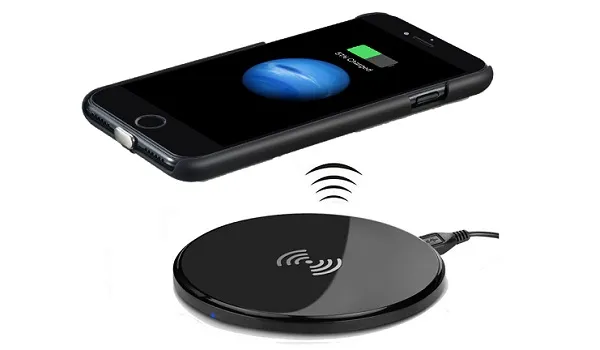
There are different wireless charging standards, developed by different teams. The most common and most popular is Qi, so you have likely heard of that. Others include: PMA (Power Matters Alliance), Wi-Po, A4WP (Alliance for Wireless Power), and iNPOFi. These others are not as widely used as Qi. As such, the wireless charging plate that you use is most likely using the Qi standard.
Wireless charging is not as efficient as wired charging. At least, not yet. Sometime in the future, that may change. There is a greater loss of power during the charging process when using a wireless charger than when using a wired charger. Wired is also still much faster than wireless. The big selling factor of being able to charge wirelessly is convenience, but it comes at the price of slower charging speeds when compared to wired charging.
- Types of Wireless Charging
- Charging By Electromagnetic Induction
- How Wireless Charging Works
- What Of Long-Range Wireless Charging?
- The Qi Standard
- Which Are The Qi Enabled Phones?
- Picking A Wireless Charger
Types of Wireless Charging
There are two types of wireless charging: inductive or electromagnetic induction, which requires direct contact by placing your device on a wireless plate, and resonant, which makes charging possible without physical contact. It does require some proximity. For now, inductive is by far the most common implementation.
Charging By Electromagnetic Induction
Inductive charging uses an induction coil to create an alternating electromagnetic field from inside a charging base, and a second induction coil in the compatible smartphone converts the power from the electromagnetic field back into electric current to charge the battery.
Inductive charging is the most popular form of wireless charging and has been built into many smartphones for a few years now. If you have heard of Qi wireless chargers, they work by inductive charging.
How Wireless Charging Works
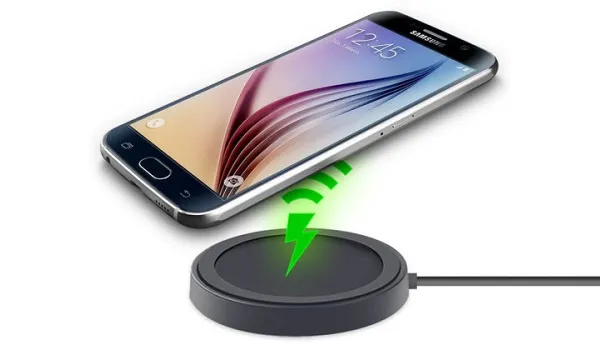
To use wireless charging, you need a charging pad. Plug the pad into a wall socket and place your Qi-compatible smartphone on it to charge. Wireless pads or plates now come in all shapes and sizes, with some of them coming in the form of small, colourful pillows.
The advantage of wireless charging is convenience: you do not have to plug and unplug your phone. Just drop it on the charging plate and carry on with your business. It is great for work desks, restaurant tables, and home furniture.
What Of Long-Range Wireless Charging?
At some point in time, you may desire something more freeing – something that does not require close proximity. A new wireless charging technology named Wi-Charge uses infra-red beams to charge devices over longer distances.
It isn’t in use yet by any smartphone manufacturers. So if you want a phone that charges wirelessly, the only available options are Qi enabled phones.
The Qi Standard
Qi wireless charging was developed by the Wireless Power Consortium (WPC). All the top mobile phone brands have adopted it, and it is what is used in most wireless chargers in the market, including those from Anker, Belkin, and Mophie.
Which Are The Qi Enabled Phones?
There are quite a number of Qi enabled phones in the market. This is because the Qi standard has become the defacto wireless charging standard for smartphones due to its huge popularity. You will find Qi enabled phones from Apple, Samsung, Nokia, LG, Huawei, Xiaomi, Sony, Sharp, and others.
Check the specifications page of the phones you are interested in to confirm whether or not they have wireless charging support.
Picking A Wireless Charger
Now that you understand how wireless charging works, you are better informed to choose a wireless charger.
If your phone is advertised as being able to charge wirelessly, then you can enjoy the convenience. All you need to so is buy a wireless charger. There is a wide range of wireless chargers in the market. They come in different sizes, shapes, designs, textures, and prices.
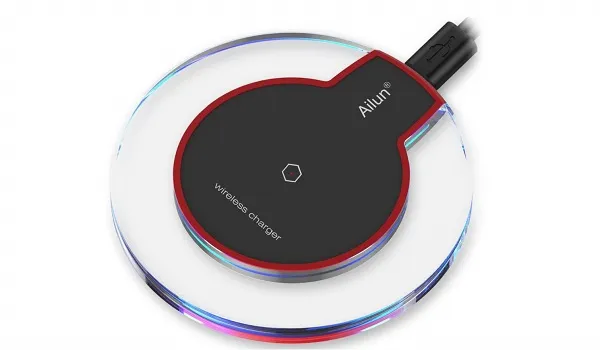
Here are a few brands that manufacture good quality wireless chargers:
- Belkin
- Samsung
- Case Mate
- Native Union
- Anker
- Yootech
- Seneo
- Aukey
- Choetech
- Ailun
New brands come up every other day though, so be sure to ask at your favourite gadget retail store.
Again, here is the summary of how wireless charging works: electricity is transferred from a charging plate to the smartphone, wearable or other device via electromagnetic waves. This means that even with a protective case on, your Qi-enabled phone will still get charged wirelessly when placed on a charging plate.
PS : You will find our related article, Fast Charging: 20W, 33W, 45W, 67W, 120W, Explained In Easy terms , interesting.
Author:Mister Mobility
Digital Skills and Communication Coach | Mobile Phone Connoisseur since 2001 | Tech Blogging since 2004
