Add MobilityArena as a preferred source on Google
Every now and then in every industry, something truly groundbreaking shows up. In the EV industry, Samsung’s new oxide solid-state battery fits that description. it offers faster charging times and longer driving range on a single charge.
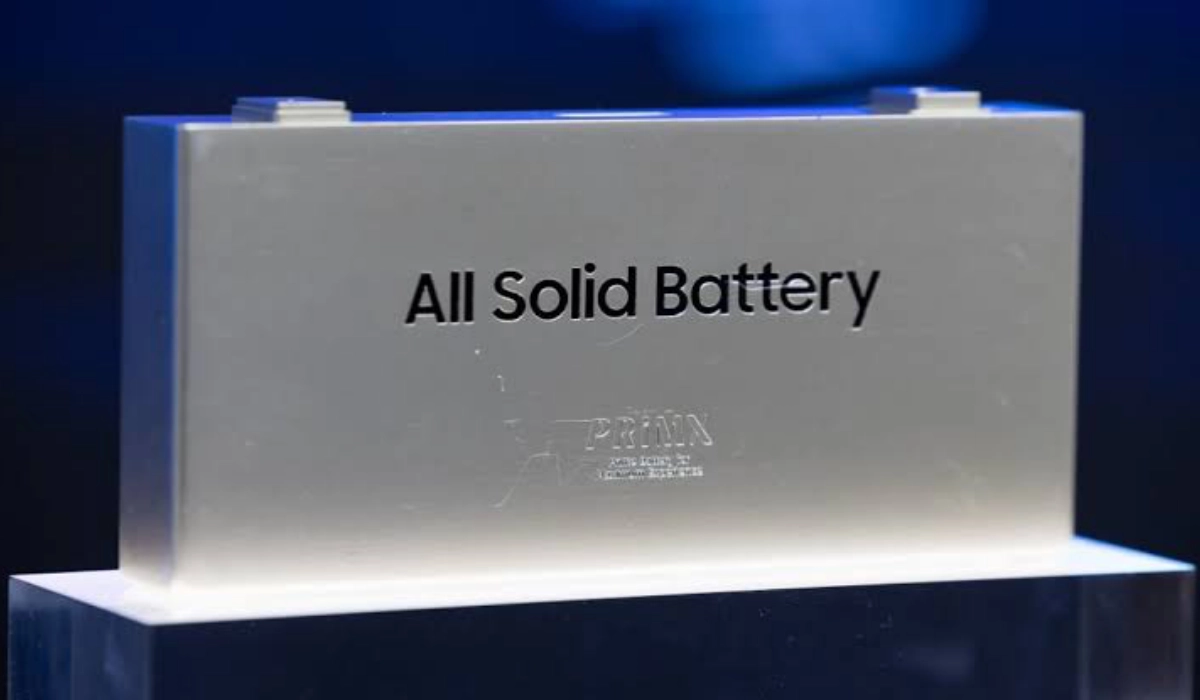
Samsung has developed a new, oxide solid-state EV battery that charges fully in just 9 minutes and can power a vehicle for 620 miles. That is roughly 998 kilometers. The current maximum range of EVs on a single charge is about 515 miles and the record holder is the Lucid Air Grand Touring, a super-premium EV that costs $139,650. A jump in range from 515 to 620 miles is significant.
However, more regular electric vehicles have much shorter ranges than this. Your average EV – the affordable models that most EV car owners drive – do between 200 and 450 miles on a single battery charge.
The new oxide solid-state battery technology delivers outstanding energy density of 500 Wh/kg, which is almost double the 270 Wh/kg density of current EV battery technology. This is the secret behind its ability to deliver much longer driving range over other types of EV batteries already in use.
Samsung says it has completed its manufacturing facility to mass produce the new battery and it will start rolling out in 2027. Because the new battery is pricey, it will be seen only in the super premium EV category, for starters. As economies of scale kicks in over time, we will see a drop in price and the new battery will trickle down to lower priced models.
But the company is developing other types of more affordable EV batteries for lower priced segments of the market. It is developing high-nickel NCS EV batteries for the premium segment. And for even more affordable models, it is also developing lithium iron phosphate (LFP) and cobalt-free batteries, both of which cost much less to produce. Samsung is definitely not playing around and intends to be a major supplier of batteries for electric vehicles of all classes and prices.
What is a solid-state battery?
A solid-state battery is a type of battery that uses solid electrolytes instead of the liquid or gel electrolytes found in traditional lithium-ion or lead-acid batteries. This solid electrolyte can be made from a variety of materials, including ceramics and sulfides.
Advantages of Solid-State Batteries
- Higher Energy Density : Solid-state batteries can store more energy in the same amount of space compared to traditional batteries. This means longer driving ranges for electric vehicles (EVs) and more power for other applications.
- Improved Safety : The solid electrolytes are less likely to catch fire or explode compared to liquid electrolytes, which are flammable and can be unstable at high temperatures.
- Faster Charging Times : Solid-state batteries can be charged more quickly than traditional batteries. Some prototypes have shown the ability to charge up to 80% in just a few minutes.
- Longer Lifespan : These batteries tend to have a longer cycle life, meaning they can be charged and discharged more times before they start to degrade.
- Reduced Weight and Size : Due to their higher energy density and the nature of solid electrolytes, solid-state batteries can be smaller and lighter, which is particularly beneficial for EVs and portable electronics.
Samsung is not the only company betting on solid-state batteries for electric vehicles. Toyota is developing on it, as well. And so is LG, one of Samsung’s key competitors.
LG, which is one of the major suppliers of EV batteries to Tesla, is developing solid-state batteries and plans to introduce them to the market by 2030. That is three years after Samsung’s battery is expected to go on sale. LG’s solid-state products will also be used in super premium EVs.
Toyota’s solid-state battery is expected in the market within a few years and the Japanese carmakers claims it will charge fully in 10 minutes and have a range of 750 miles (about) 1,200 kilometers. That is ambitious and will leave Samsung’s new battery in the dust, if actualized. And that will be a good thing, again, for the industry. Afterall, what we all want are electric vehicles with faster charging and longer driving range.
Author:Mister Mobility
Digital Skills and Communication Coach | Mobile Phone Connoisseur since 2001 | Tech Blogging since 2004
Add MobilityArena as a preferred source on Google
Computers have been around for decades but never have they been as powerful as they are now. And by “powerful”, I am not referring to the raw power that computer processors have today; I am referring to how useful they have become. And there is no better example of this than in how artificial intelligence (AI) has changed computers from glorified calculators to tools that can learn, communicate, and evolve on their own.
With Generative AI, computers are able to not just acquire, classify, and communicate information from other sources, they are also able to generate new original content all on their own. Some say computers have finally learned to “think” for themselves, and that is not far from the truth.
Generative AI, sometimes also called gen AI, is artificial intelligence that can create original content, whether we are talking about text, images, video, audio, or even software code, in response to human request. We call these human requests, “prompts”. It relies on sophisticated deep learning models, which simulate the learning and decision-making processes of the human brain.
Example applications of Generative AI
Gen AI can be applied to pretty much any field of human endeavor. This includes non-formal matters, such as home keeping, raising your children, etc. Industry-wise, gen AI is applicable in every field possible – healthcare and medicine, manufacturing, financial services, media and entertainment, education, legal services, advertising and marketing, construction services, to name a few.
For example, in manufacturing, gen AI can be used in creating prototypes, optimizing design, and process automation. In the field of building and construction, for example, AI can be used to draw quick drafts, it can help you explore climate adaptation, as well as new, innovative design approaches.
Some well-known Generative AI assistants and tools
Having established that AI is applicable across all sorts of fields, below, I explore and list some of the most popular generator AI assistants and tools across various categories of tasks and endeavors.
General-Purpose AI Assistants
- ChatGPT (OpenAI): A versatile language model capable of generating text, translating languages, writing different kinds of creative content, and answering your questions in an informative way. Quick tip: The “G” in ChatGPT stands for the word “generative”.
- Google Bard: Another powerful language model developed by Google, offering similar capabilities to ChatGPT.
- Copilot: Microsoft’s AI-powered chatbot, integrating search capabilities with generative text.
AI Writing Assistants
- Jasper.ai: Specializes in copywriting, generating various marketing materials like ad copy, social media posts, and blog content.
- Copy.ai: Another popular choice for copywriting, offering a wide range of templates and tone options.
- SurferSEO: Focuses on SEO-optimized content generation.
AI Image Generation
- Midjourney: Creates stunning images from textual descriptions.
- Stable Diffusion: Open-source image generation model, offering flexibility and customization.
- DALL-E 2: Generates highly detailed and realistic images from text descriptions.
Mobile Phone Generative AI tools
Smartphone brands are also developing their own gen AI tools which they are baking into their custom mobile operating systems. Some of them include:
- Galaxy AI: Samsung’s homegrown generative AI suite.
- Apple Intelligence: introduced in iPhones in 2024.
- AI Eraser, AI Recording Summary: developed by OPPO Mobile.
Limitations and cons of Gen AI
Generative AI has been known to produce inaccurate or nonsensical output. There are times I have asked AI a question, and while much of the response was sound and useful, it very often injects wild, inaccurate information – sometimes blatant falsehood somewhere in the middle of its answer. This is one key reason why you cannot afford to 100% outsource your work to AI.
How best to use Generative AI
While there is the temptation to go the lazy route and try to use Gen AI to do all of your work e.g. to create all your content, that is a bad idea and certainly one of the worst ways to use this new technology. Generative AI is not here to replace human input or intelligence; it is here to assist or enhance it.
As such, the best way to use Gen AI is to think of it as your assistant. Your brilliant research assistant who can help you easily find information that would have taken your hours or days of work to fish out. Or an assistant who can help you navigate your way around complex concepts.
Think of AI as a brilliant but imperfect assistant, because it really is imperfect. Your domain expertise must be involved in your work at all times, if you are interested in getting the best out of Generative AI. It works best as your assistant who helps you with more mundane tasks so you can focus on the more important tasks or things about your work or about life.
And because AI communicates like any regular person does – in normal everyday conversational language, you can ask it how best it can help you with specific tasks. How do I mean? Supposing you are a student, you can ask, “I am a college student preparing for XYZ course work. How can you help me achieve the best results?” You just might be surprised what responses you will get.
Don’t forget: the better (more precise, more specific) the questions you ask, the better the answers you will get. As such, you must fine-tune your ability to ask questions. The difference between great interviewers and ho-hum interviewers is largely in how pointed they are with their questions – their ability to point their interviewees in the right direction.
Author:Mister Mobility
Digital Skills and Communication Coach | Mobile Phone Connoisseur since 2001 | Tech Blogging since 2004
